Tokyo, San Francisco and Istanbul - a tour of 3 fantastic shows and what to expect…
By way of introduction, Thomas Ang is a well known nib expert, indeed, Thomas has provided excellent services to my clients and I for a while. I knew that Thomas was on quite a journey to non-UK shows and asked if he would mind contributing a blog article for these far flung and exotic gatherings of pen and stationary enthusiasts! Thomas very kindly agreed, but we have both been very busy. With thanks to Thomas for his patience, here is his blog post:
“As I write this, Istanbul Penfest is just about wrapping up its 4th year; last weekend featured the grand marketplace that is the Tokyo International Pen Show. Not grinding nibs in Istanbul meant that I could go to TIPS for my first time in three years as a customer rather than a vendor, but only a few weeks from now, the 2025 Singapore Pen Show will kick off, hosted by our very own Vince and Michael!
The international pen show circuit is a busy affair, with organisers generally trying not to fight each other for essentially the same community. I only started tabling at the 2023 Spring LPS and never really intended to do shows elsewhere, but as luck would have it, things have only been on the up for nib workers as awareness of the fountain pen hobby spreads, and Singapore 2025 will be my 14th pen show!
For showgoers, though, planning to travel to a pen show is a very different business. Quite apart from the money spent at the show, you’ll want to think about travel expenses, food, maybe going as a group, even a language barrier… it can all add up to a really stressful logistical nightmare! So here’s a little blogpost about the international shows I’ve been in, and what they’re known for.
The big one in the fountain pen world is undoubtedly the Tokyo show. Washington DC has its Supershow every year but I think Tokyo has it beat for the sheer range of rare stuff, and this has been a long time in planning for me. So many Japanese stores turn up here, as well as others from Taiwan, South Korea, and all across Asia (from west, to south, to south-east). For many of them, it makes little economic sense to cross the Pacific to turn up at an American pen show, especially as shipping inventory into the US is getting unpredictable.
This was my first time turning up at an Asian pen show, and I was extremely impressed by how orderly it was. There are staggered entry times and lots of translators and English-speaking staff on hand to deal with the large international crowd, and the show itself, happening over two floors, has a fantastic layout that means that human traffic never ever built to unmanageable levels. Everyone was given a show map upon entry in Japanese or English, and each table was neatly signposted with the vendor’s name or brand. There was also plenty of space between various rows of tables so people could stop and browse without getting in others’ way, and having specific entrances and exits (and suitable enforcement!) was also a major factor in maintaining this smooth flow, which I’ve never seen anywhere else.
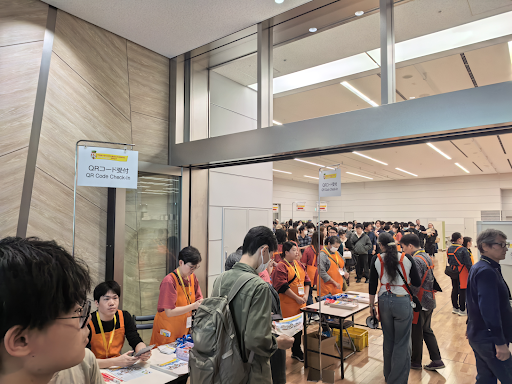
the check-in station
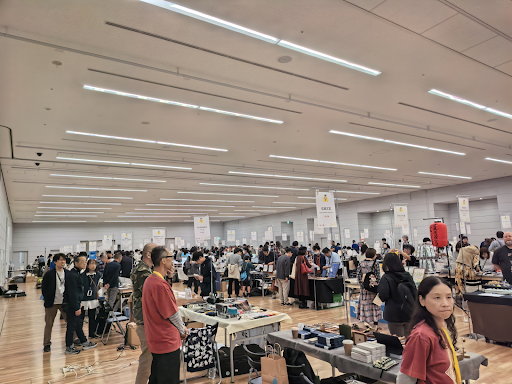
one floor (of two) in the show
When coming to the Tokyo show, really save up for it. Exclusives abound: it seems like every shop has its own exclusive inks from Sailor, or Diamine, or Tono & Lims. Some even have limited-production pens. There are also lots of collaborations with local artisans, like this double-nibbed glass pen from Bungubox featuring Synchronicity Glass Art, alongside a new Vanishing Point for Bungukan Kobayashi (in a limited release of 300):
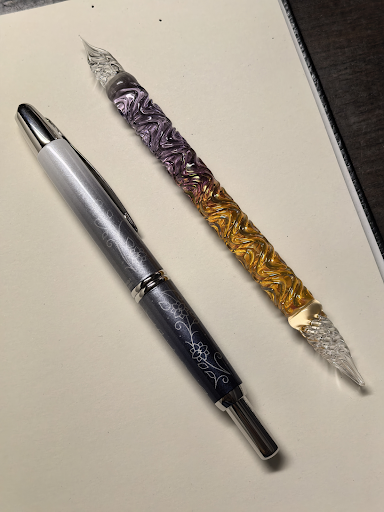
Synchronicity Glass Art dip pen, alongside a new Pilot Vanishing Point for Bungukan Kobayashi (in a limited release of 300)
And, of course, it being Japan, the store hunt is a must. Maruzen doesn’t turn up at the show, and they have some exclusive inks themselves. Ancora, in Ginza, has some real video-game side-quest inks: one sold only when it’s raining, and another only around the day of the full moon! Itoya is too big to care: I feel like they know that whenever November rolls around, TIPS showgoers will come and fill their two buildings anyway. Even a well-travelled vendor like Bungubox will sometimes leave some pens behind. I had to go to their store in Jimbocho to run an errand for a friend, which involved this “Love Pink” Sailor Realo:
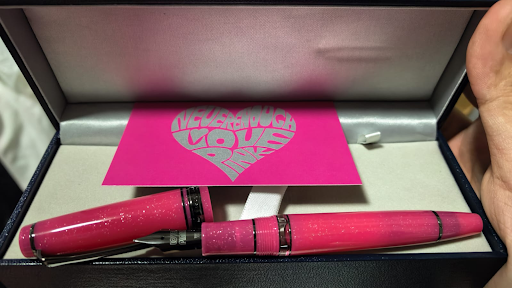
“Love Pink” Sailor Realo
And the fun about Tokyo is that it’s huge and there’s tons of fun places to ferret out good finds. Tsutaya, a bookstore chain, had a really beautiful calligraphy exhibition in Meguro and some exclusive inks by TAG in their store in Ginza Six, where I also stumbled upon a gold-trimmed clear brown Custom 912 just on display in a shelf. Needless to say, that came home with me:
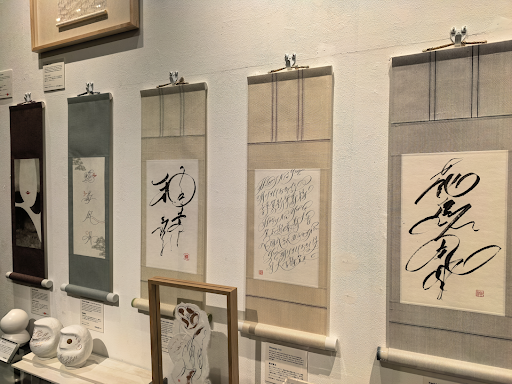
Superb examples of Japanese calligraphy at Tsutaya
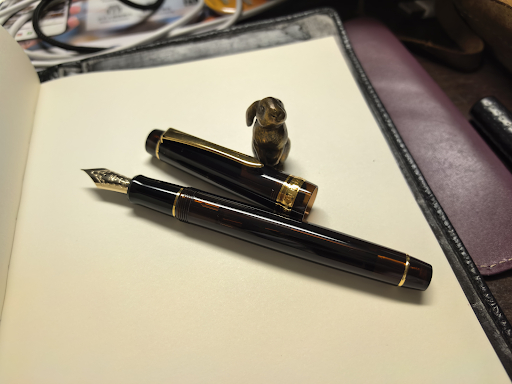
Pilot 912 in unusual brown colour way
But since I’m ultimately a nib person, the count that matters to me is that there were 5 nib grinders: Gena Salorino and Matthew Chen, both stalwarts of the US show circuit who also find time for TIPS and for Manila in March; Nagahara and his son (the 2nd and 3rd generations of the family), and Taku, working for Frank Zhang’s Omas (the American version of the company). Acquisitions are the main draw of the Tokyo show, and rightly so, even to the point that a fair few of the tables had specific sections for preorder pickups, and one vendor was only delivering preorders and had nothing for general sale.
In contrast, a show like San Francisco has, as one of its main selling points, four days of workshops and classes with various experts that you can sign up for. The show itself runs from Friday to Sunday at the end of August, but showgoers descend on the venue as early as Wednesday night for classes that begin on Thursday morning. I went to a calligraphy class run by Nikola Pang this year, knowing that my entire weekend would be packed full of nib work.
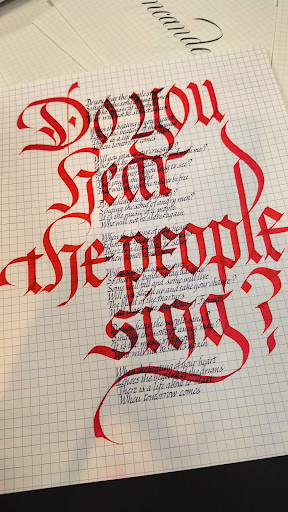
Nik Pang’s calligraphy example
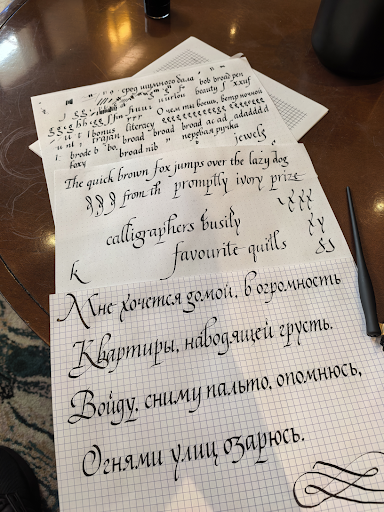
my work at the end of the class
There are art classes of many sorts — urban sketching, scrapbooking, ink washes and painting, and calligraphy; there are introductions to nib tuning; talks and discussions on various topics ranging from vintage collection to specific things like Italian or Japanese pens. The crowd is huge and knowledgeable and people are more than willing to barter and trade, even late at night under the influence of lots of alcohol!
San Francisco is a show where you want to do your homework before arriving, because regular vendors do get moved around from year to year. There is sizable representation from Japanese vendors, but some of the most interesting stuff comes from small makers working all across America: Shawn Newton is a long-established name, as is Carolina Pen Company or Schon DSGN, but also names like John Tello (Hello Tello Studio) or Skogsy Pens that don’t get that much attention outside the US, all of which have their own fun quirks.
SF is the big show of the West Coast and, in contrast with the DC Supershow, has less representation in vintage pens. Instead, there are lots of vendors who do only accessories: Musubi, from Singapore, does a brisk notebook business there, as does Yamamoto Paper, and there’s a good number of people selling stickers, stamps, washi tapes, pen cases, leather goods, and many more besides, all dotted over the space.
There’s also a lot to go for on the high end here. Aesthetic Bay, the world’s largest mover of Nakaya pens, book out several tables and always have stunning wares on display. Eboya’s ebonite pens are also hugely popular. There’s a large cohort of Japanese urushi, maki-e, and raden too: Tohma and Furuta both have huge urushi pens with extra-large gold nibs, and Bokumondoh often sells out early on. StyloArt Karuizawa and seY Pens do very well too.
For me, the impressive thing about American shows is how far people are willing to drive to get to them. Flying is one thing — the SF show venue is easily reached by free shuttle from the airport — but people drive from as far afield as Arizona or even Vancouver. And a lot of it is due to the sheer number of nib workers that show up to SF. People really do set aside pens for months just to come to SF and get everything worked on at once, often with multiple nib people. This year there were a whole dozen of us, all of whom were kept extremely busy throughout the weekend. I was very honoured to get to be in such august company!
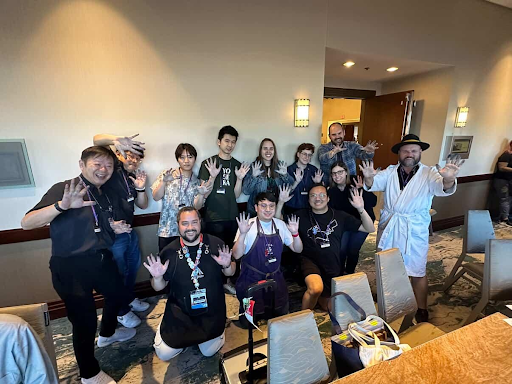
The dirty dozen nib people!
The explosion in the fountain pen hobby in recent years also means new players have come on the block with regards to pen shows. Turkish companies like Galen Leather have already been getting attention anyway, and vendors like Stüdyo Ağaçkakan also go to international shows, so it was no major surprise when Istanbul Penfest kicked off in 2022. The 2023 edition was one of my very first shows, and a good way to cut my teeth on travelling to do nib work! Unfortunately, since I’m writing this from Japan, I’m missing out on hanging out with friends I’ve made over the past two years.
The Istanbul show is a fantastic example of what a pen show can be if there’s official support behind it. After all, the venue is unlike any other: Çırağan Sarayı, or the Ciragan palace, was historically the palace of the Ottoman sultan, and it sits on the European bank of the Bosphorus. If you fancy some fresh air, there’s a side exit that takes you onto a promenade where you can look over at Asia!
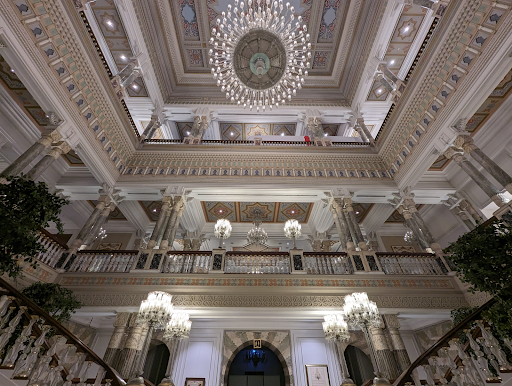
Inside the Istanbul show 1
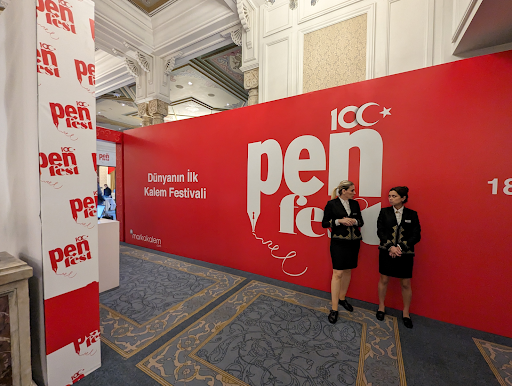
Inside the Istanbul show 2
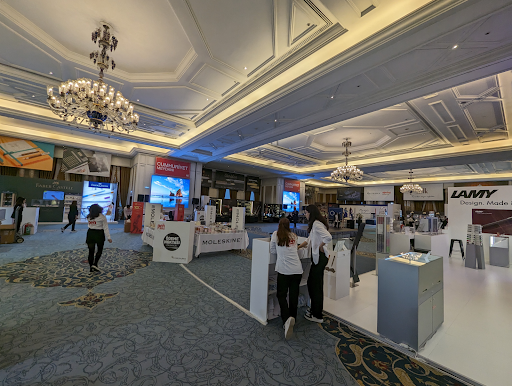
Inside the Istanbul show 3
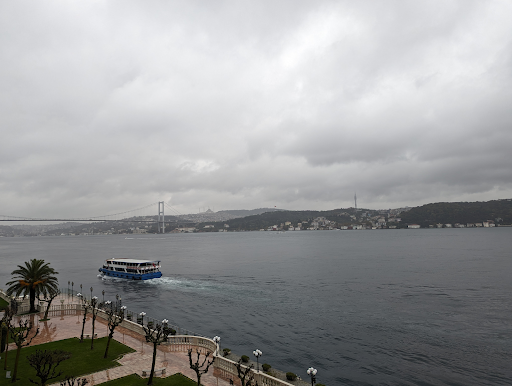
Wonderful view from the show over the Bosphorus
In 2023, the 100th anniversary of Turkish independence, it felt like a huge celebration of fountain pen and calligraphy culture in the country, and, both years I attended, government ministers and the media came and chatted with vendors and showgoers alike. I even got an interview and a nice photo of myself in TRT:
Istanbul’s show is the one show I’ve been to that has had the most brand sponsorship. The floor layout also emphasises this, with a separate hall for official corporate representation (Lamy, Montblanc, and Faber-Castell are the three big spenders here), along with a hype man conducting raffles, quizzes, and giveaways. The rest of the space, two long, wide corridors connecting to another open hall, is given over to an artists’ section (calligraphers, painters, scrapbookers), an ink and notebooks section, and an accessories and vintage market. Lots to look at, and the genres help manage traffic flow, which does get busy.
However, the crowd is much more general than at other pen shows, where hobbyists dominate. I did have to explain what I was doing far more than anywhere else, which involved an interpreter a good bit of the time, and newbies were understandably nervous when they saw me power up my tools next to their expensive pens! It’s a good place to explore, though, and features a lot of local craftsmanship, which doesn’t necessarily travel all that much. I bought some pins, loose decorative papers, and leather things from various Turkish stands; one of them, a lovely engraved silver brooch from Zeki Karaca, is now a regular fixture on my lapel when I’m at shows. Certainly a very different vibe from any other show!
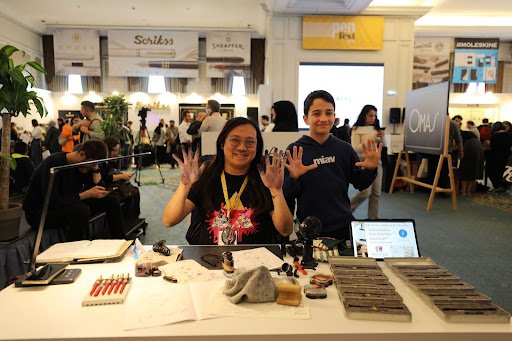
Thomas and an Istanbul show attendee
I hope you have enjoyed reading about these shows and what the experience of attending is like. If you did the round trip you would cover (the internet tells me) approx 22,000 miles! Each show has something special to offer, both as a nib grinder and as a collector and user of pens. If you can, I thoroughly recommend a trip to one of these shows, or indeed any show, to see pens, meet people and get a nib ground to your preference. The UK show calendar for 2026 looks exciting and hopefully accessible for many. Thank you for reading and I look forward to grinding a nib for you soon!"